Lab-grown diamonds have gained immense popularity in the jewelry industry, as they serve as modern alternatives to natural diamonds. They look so identical to natural diamonds that it’s hard to tell them apart.
In this article, we will explain what a lab-grown diamond is, how it is made, the authenticity, how it compares to natural diamonds, and why it’s great for jewelry collections.
What is a Lab-Grown Diamond?
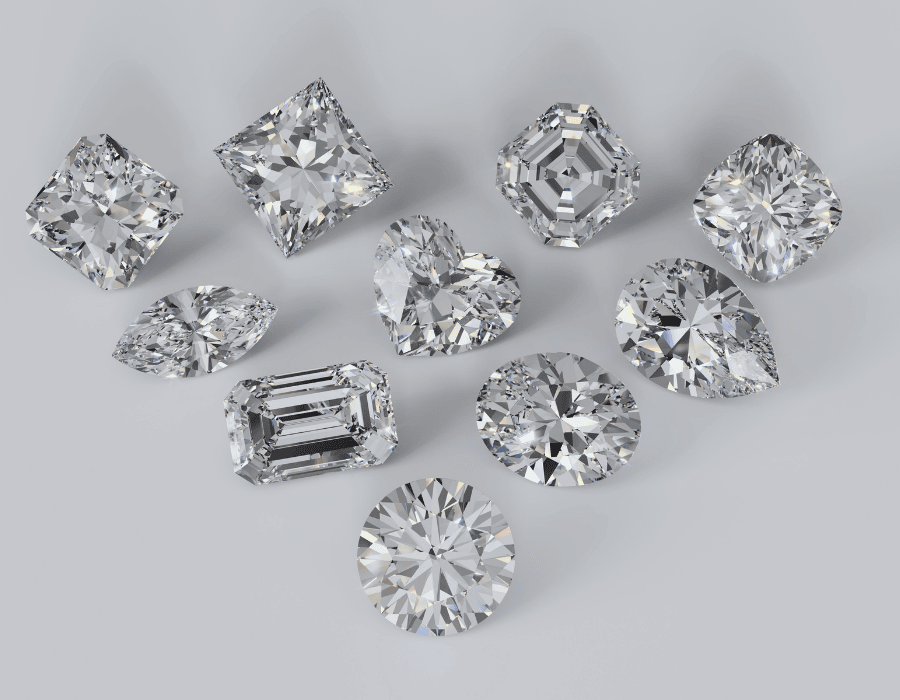
A lab-grown diamond is a gemstone created in a controlled laboratory using advanced technological processes. It has the same chemical composition, crystal structure, and physical properties as a natural diamond. But unlike natural diamonds that take billions of years to form under the Earth, lab-grown diamonds are created in weeks.
How is a Lab-Grown Diamond Made?
Lab-grown diamonds can be created through two methods, which both involve first of all getting tiny seeds from pre-existing diamonds.
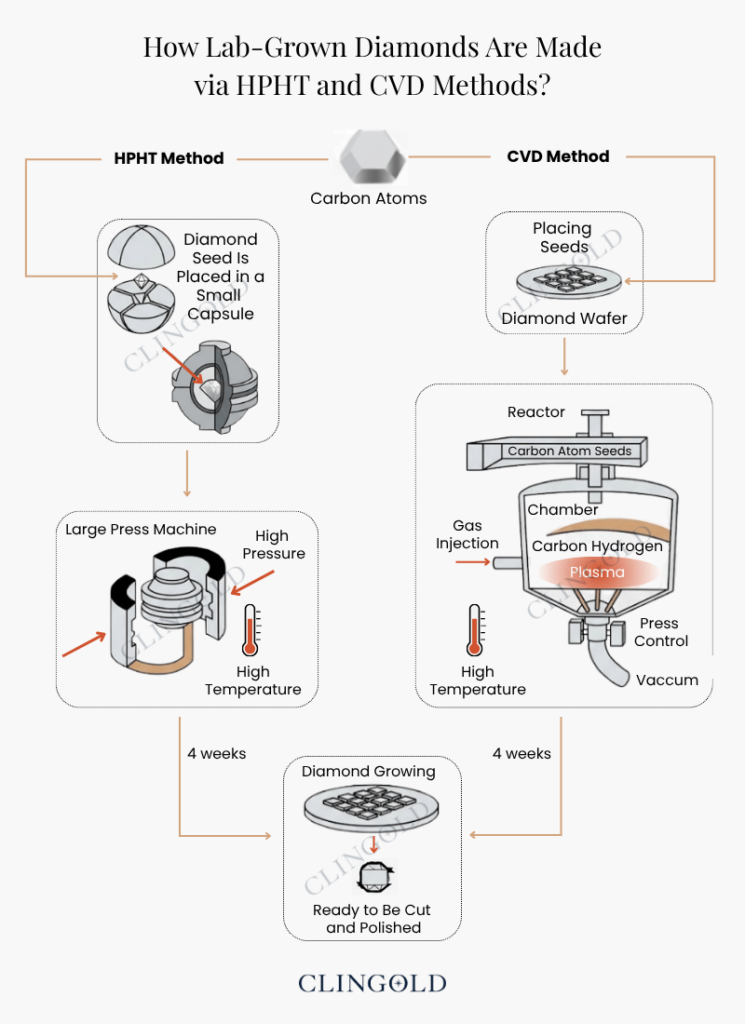
Method 1: HPHT (High Pressure High Temperature)
This method mimics Earth’s natural conditions for creating diamonds by applying extreme heat and pressure to tiny carbon seeds.
HPHT Process
- A small diamond seed is placed in the chamber.
- The chamber is filled with intense heat (over 2,0000C) and pressure (1.5 million pounds per square inch).
- The carbon atoms in the chamber melt and bond to the seed, which then crystalizes into a diamond.
- The result is cut and polished into a sellable diamond.
Method 2: CVD (Chemical Vapor Deposition)
This is a more modernized method, where the carbon-rich gas in a vacuum chamber is used to grow diamond crystals layer by layer onto a seed.
CVD Process
- A small diamond seed is placed in the vacuum chamber.
- The chamber is filled with a carbon-rich gas (majorly methane and hydrogen).
- The gas is heated till it releases carbon atoms.
- The carbon atoms bond to the seed, forming layer by layer until the diamond reaches its desired size.
- The result is cut and polished into a sellable diamond.
How Long Does It Take to Make a Lab-Grown Diamond?
Creating a lab-grown diamond usually takes a few weeks depending on the size. But averagely, within 4 weeks, most lab-grown diamonds are ready.
Is a Lab-Grown Diamond Real?
Yes, a lab-grown diamond is a real diamond. It has the same chemical composition (pure carbon), crystal structure, and physical properties as a natural diamond. This means it is just as hard, durable, and brilliant as natural diamonds.
This was further attested to by Stephen Morrisseau, a spokesperson for the Gemological Institute of America (GIA), who said: “man-made diamonds are not fakes…they have all the same physical and chemical properties of a mined diamond.”
In fact, in 2018, the Federal Trade Commission (FTC) updated its Jewelry Guides by removing the word “natural” from the definition of a diamond. It now defines a diamond as “a mineral consisting essentially of pure carbon crystalized in the isometric system.”
What’s the Difference between lab-Grown and Natural Diamond?
Here’s how a lab-grown diamond differs from a natural diamond:
| Feature | Lab-Grown Diamonds | Natural/Mined Diamonds |
| Origin | Created in a laboratory using HPHT or CVD technology | Formed naturally within the Earth |
| Environment | Produced in controlled, high-tech lab conditions | Produced under extreme heat and pressure beneath the Earth’s surface |
| Ethics | Conflict-free with a transparent production process | Not always transparent and conflict-free, but the Kimberley Process helps to solve this problem |
| Price | About 30-50% more affordable for the same size and quality | More expensive due to rarity and mining costs |
| Availability | Widely available and easier to source in consistent quality | Limited supply; natural diamonds are harder to find |
The 4Cs of Diamond/Lab-Grown Diamond Grading
The 4Cs (Cut, Clarity, Color, and Carat) are the global standard for grading the quality and value of diamonds, whether natural or lab-grown.
Diamond Cut Grades
How a diamond is cut determines how well it will shine and sparkle. The more precisely a diamond is cut, the more its brilliance.
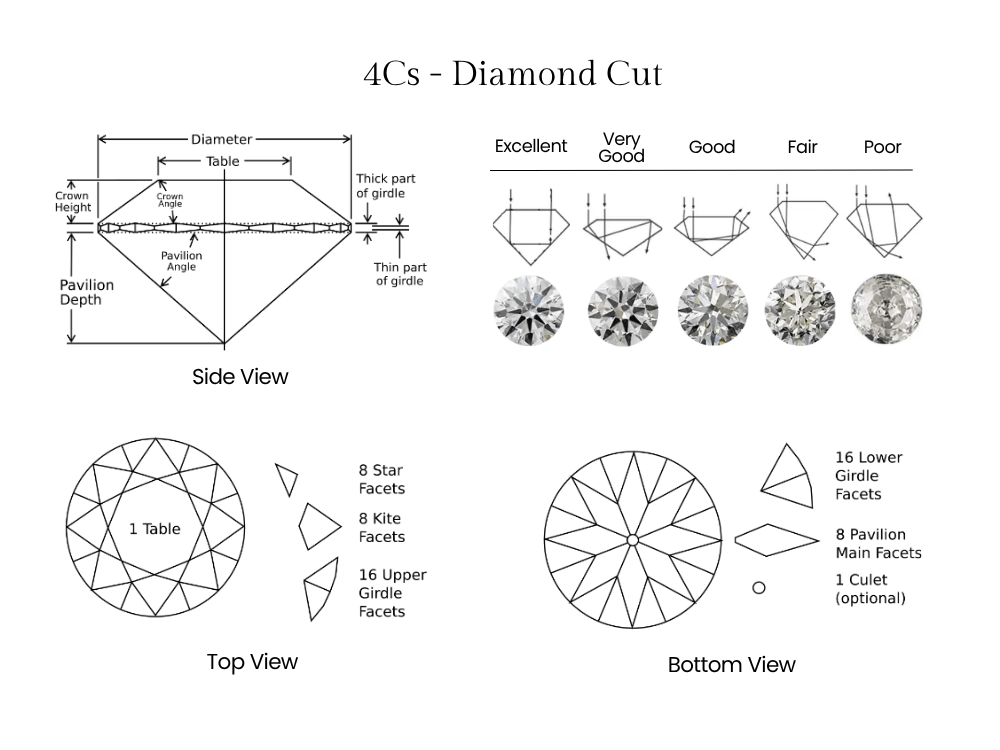
- Excellent: This is the highest cut grade, offering maximum brilliance and fire. The diamond is cut with precise craftsmanship to create the most dazzling effect.
- Very Good: Reflects most light efficiently and offers strong sparkle. Nearly as brilliant as Excellent, with only slight deviations in the geometry.
- Good: Provides decent brilliance but allows more light to escape, which reduces the overall sparkle.
- Fair: Noticeable loss of brilliance due to poor light reflection and less precise cut proportion.
- Poor: A badly cut diamond that looks dull and lifeless. It gives minimal sparkle and excessive light loss.
Diamond Clarity Grades
The clarity grades refer to the absence of inclusions or blemishes. The clearer a diamond, the more valuable it is.
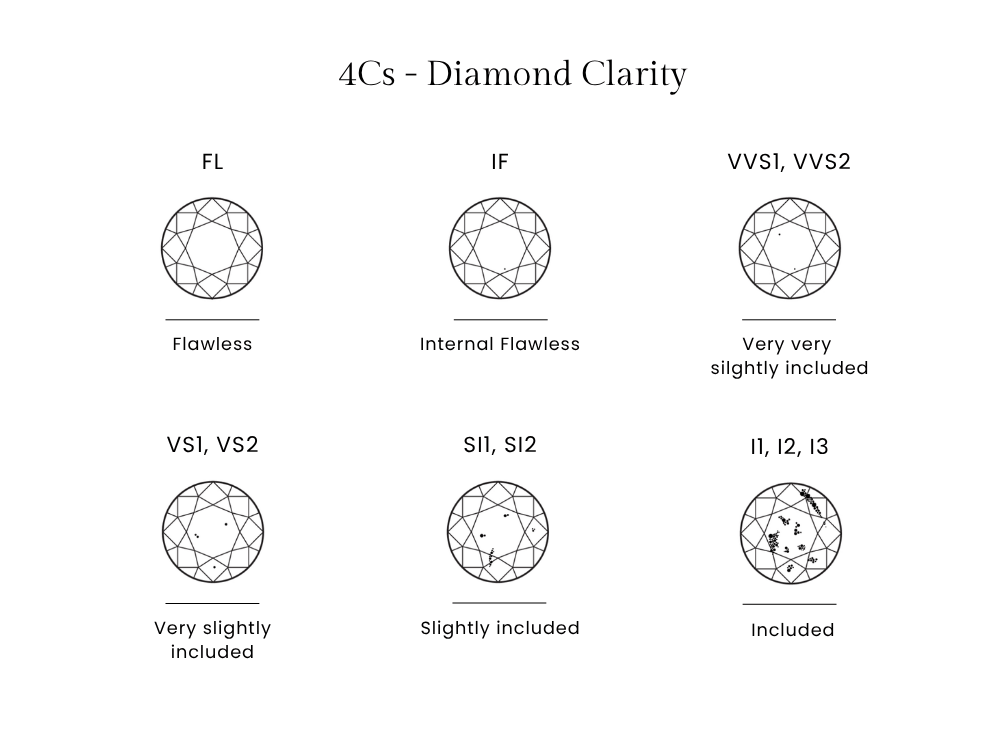
- FL (Flawless): No internal or external imperfections visible under 10x magnification.
- IF (Internally Flawless): No internal inclusions; only minor surface blemishes under magnification.
- VVS1, VVS2 (Very Very Slightly Included): Minute inclusions that are extremely difficult to detect even for experts.
- VS1, VS2 (Very Slightly Included): Minor inclusions visible under magnification but completely invisible to the naked eye.
- SI1, SI2 (Slightly Included): Noticeable inclusions under magnification; may be visible to the naked eyes in some cases like SI2.
- I1, I2, I3 (Included): Inclusions are generally visible to the naked eye, and they affect the transparency and brilliance of the diamond.
Diamond Color Scale
This is basically a measure of how colorless the diamond is. The more colorless a diamond is, the rarer and more valuable it is.
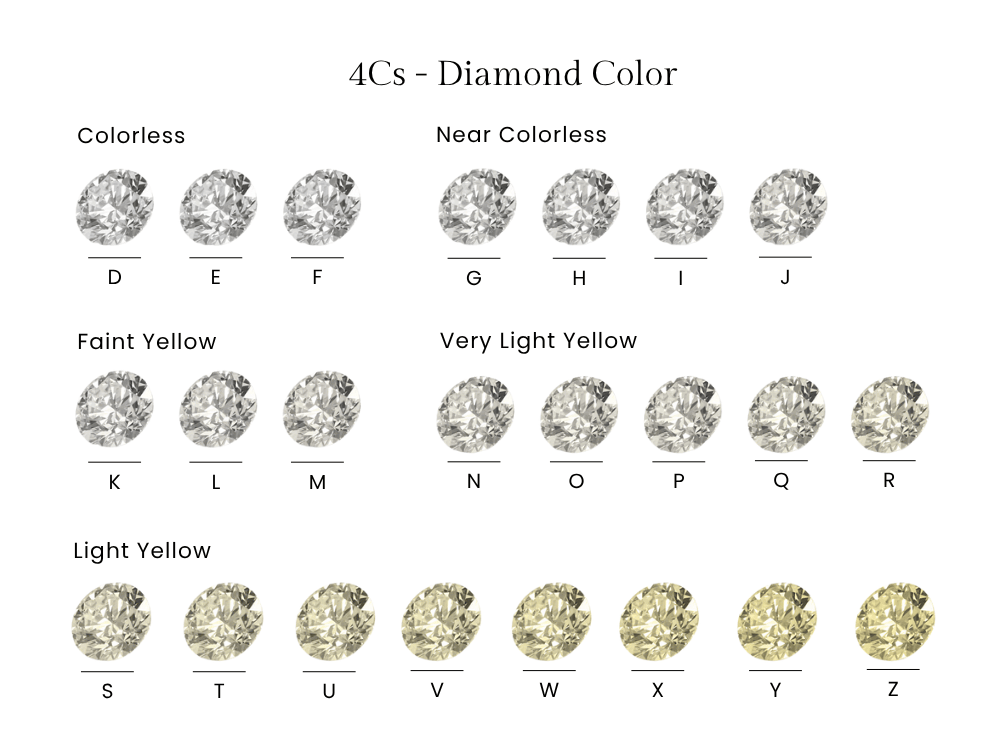
- Colorless (D, E, F): Completely colorless diamonds, with the highest value and exceptional brilliance.
- Near Colorless (G, H, I, J): Slight traces of color that’s usually undetectable to the ordinary eye.
- Faint Color (K, L, M): Noticeable warm tint, especially in larger stones or certain lighting.
- Very Light Color (N-R): Visible yellow or brown tint that slightly affects appearances.
- Light Color (S-Z): Obvious color presence, often reducing the diamond’s brilliance and overall value.
Diamond Carat
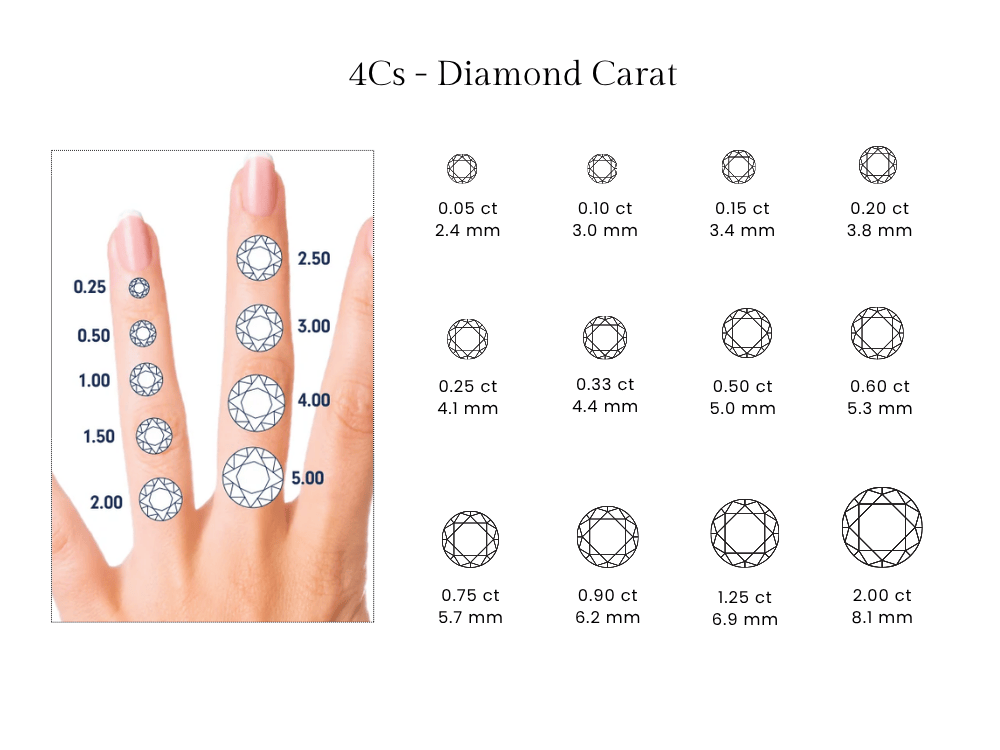
Carat refers to a diamond’s weight, not its size. A diamond can be very large but weigh less when compared to a smaller diamond. One carat is equivalent to 200 milligrams (0.2 grams). Thus, the higher the carat, the more valuable the diamond.
However, carat should be balanced with cut, clarity, and color to ensure overall beauty. A well-cut smaller diamond can often appear more brilliant than a larger, poorly cut one.
How Can You Tell If a Diamond is Lab-Grown?
Telling a lab-grown diamond apart from a naturally-formed one is nearly impossible with the naked eyes. The most reliable way to differentiate them is to check their professional grading report.
Another way to know if a diamond is lab-grown or not is to use advanced equipment and methods used by gemologists, such as spectrometer, Photoluminescence Spectroscopy, or Cathodoluminescence Imaging.
Also, check the diamond for a laser inscription. It may indicate the lab it’s made from.
Will a Lab-Grown Diamond Pass a Diamond Tester?
Yes, lab-grown diamonds will pass standard diamond testers because they have the same thermal and electrical conductivity as natural diamonds.
Most testers are designed to distinguish diamonds from stimulants like cubic zirconia, not to detect their origin or how they are made. As a result, this lab-grown gemstone will register as genuine diamond.
What is the Best Clarity for a Lab-Grown Diamond?
The best clarity for a lab-grown diamond is typically VS1-VS2. These grades have minimal inclusions that can only be detected under magnification. They provide a balance between beauty, performance, cost efficiency, and are perfect for fine jewelry.
While FL is the highest clarity grade, it’s just like VS1-VS2. They both have inclusions that cannot be seen with the naked eye. FL requires 10x magnification to detect inclusions. VS1-VS2 requires less magnification, making them less expensive and practical for most buyers.
Why Choose Lab-Grown Diamond for Your Jewelry Collection?
Lab-grown diamonds are more affordable when compared to natural diamonds. That is to say you can buy higher-quality options for your jewelry collection without spending too much.
Also, lab-grown diamonds are sourced ethically, which means you don’t have to worry about illegal mining issues. They are even manufactured in a controlled laboratory. This way, the environment is safe.
For consumers and jewelry brands alike, lab-grown diamonds provide a smart balance of sustainability, affordability, and design flexibility.
If you’re ready to explore high-quality options, it’s advisable that you work with a trusted gold jewelry manufacturer that can help you create pieces that align with your values, styles, and budget.
Conclusion
Lab-grown diamonds (also known as man-made diamonds) have the same brilliance, durability, and composition as natural diamonds.
They are as real as natural diamonds in every sense. The only difference is how they are made.
- Lab-grown Diamonds: Made in high-tech labs using advanced methods within a few weeks.
- Natural Diamonds: Formed in the Earth’s mantle over billions of years and extracted through mining.
Also, natural diamonds are more expensive and sometimes face ethical concerns—which lab-grown diamonds are free of.